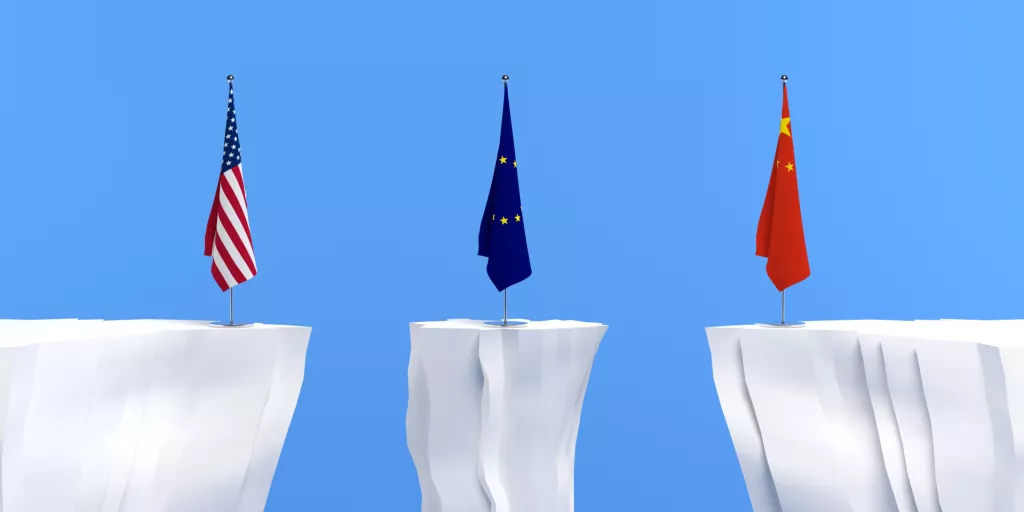
The European Union and the United States are currently nearing an agreement regarding new tariffs that the US threatened to impose on European imports. The US administration announced plans to introduce a 30% tariff on a wide range of EU products starting August 1st, escalating prior trade tensions between the two economic powers. However, recent negotiations suggest both sides are moving toward a compromise that would avoid a harsh trade war.

The expected outcome is a mutually agreed universal tariff rate of approximately 15% on certain European goods, such as automobiles. This would represent a middle ground between the US’s initial 30% demand and the EU’s opposition to any new tariffs. This approach is modeled after a recent agreement between the US and Japan, in which both sides reduced tariffs to 15% in select sectors. The goal is to avert severe disruptions to transatlantic trade and economic growth.
At the same time, the European Commission has prepared contingency measures if the negotiations fail. In that scenario, the EU intends to implement counter-tariffs on up to €93 billion worth of US exports, also imposing tariffs as high as 30% on key American products. This tit-for-tat response aims to protect the European industry from unfair market access and to pressure the US to reconsider ill-advised tariff hikes. The EU is also considering activating its newly developed anti-coercion instrument, which could allow it to target US digital and financial services should further trade provocations occur.
Regarding the current status of talks, intense diplomatic efforts continue behind closed doors. The US insists that tariffs will commence on the announced date as leverage in bargaining but remains open to freezing or reducing them if an acceptable deal is reached. The EU seeks a durable arrangement that not only mitigates tariffs but also addresses deeper trade issues, such as subsidies, market access, and regulatory barriers.
For Croatia, although it is not a major exporter to the US and lacks sensitive sectors such as automotive manufacturing, the ongoing dispute still carries risks. Croatian companies could suffer indirectly as their primary commercial partners in the EU—such as Germany, Italy, and Austria—are particularly exposed to a potential “trade war” scenario. A slowdown in those economies generated by tariffs on EU exports could lead to a decline in demand for Croatian exports, reduce investment, and hinder economic growth.
In numerical terms, Croatia exported roughly €805 million worth of goods to the US in 2024. The largest share of these exports, approximately 40%, consists of pharmaceuticals, an industry that is partially exempt from the new tariffs. Other relevant sectors include electrical equipment and metal products, which together account for around 35% of Croatian-US trade. Should tariffs expand or persist, sectors linked to broader EU supply chains could be affected, indirectly impacting Croatian manufacturing and exports.

The Croatian government is actively coordinating with EU institutions to safeguard national interests. It advocates for exemptions where possible and prepares to mitigate any fallout. Domestic businesses have expressed concern about the pressure tariff disputes exert on market stability and are monitoring developments closely.
Beyond the EU-US dynamics, the tariff situation influences the global balance of trade, especially regarding China and Asian economies. The US is pursuing bilateral trade deals with key Asian countries, including Japan, Vietnam, Indonesia, and the Philippines, in exchange for reduced tariffs. These agreements aim to prevent China from circumventing US tariffs by routing goods through third countries. This strategy aims to counter China’s dominant export role and augment US trade leverage.
Meanwhile, China faces mounting pressure from both the US and the EU. Although the EU maintains an official dialogue with Beijing, there are serious disagreements over issues such as subsidies, market access, and China’s alignment with Russia. The EU aims to “derisk” supply chains by diversifying away from China without triggering a full-blown trade conflict. China, on its part, is deepening relationships with non-Western partners and cautiously engaging with Europe, although breakthroughs are limited.
In conclusion, the impending agreement between the EU and the US on tariffs is pivotal for Europe’s economic stability and geopolitical influence. Croatia, although not directly targeted by new tariffs, remains vulnerable to indirect consequences due to its integration into European value chains. A lasting solution would ease tensions, support economic growth, and maintain predictable trade rules. At the same time, the evolving trade relationships with China and Asian countries signify a reshaping of global economic patterns, with long-term implications for Croatian exports and investments.
Croatia’s economic actors, government officials, and industries will continue to closely monitor the situation and align with EU policies to protect national interests and capitalize on new opportunities arising from this complex and rapidly evolving trade environment.

About the Author